Average Reviews:

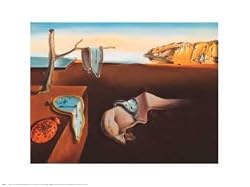
(More customer reviews)I think I could make a compelling argument that Salvador Dali?'s "The Persistence of Memory" is the most famous painting of the 20th century. Certainly it is his most memorable Surrealist work and the one that he is most often associated with in the popular mind. In addition to the typical Dalinian landscape there is what appears to be an amorphous self-portrait of the artist that is melting along with three of the more watches that provide a literal representation of the irrelevance of time.
Dali's inspiration for the famous image of the melting clocks was some Camembert cheese that had gone all soft and runny. Having completed the background of the painting, which shows the beach near his hometown of Port Lligat and the craggy rocks of Cape Creus, Dali? needed something for the foreground and came up with the idea of the melting clocks. Biographers have speculated that the artist had been spending a pleasant summer with no real sense of how time was passing and that this explains the psychological meaning of the images.
This art poster has a 24.5 x 18 inch image size on 30 x 24 inch paper, which is actually larger than the original oil on canvas painting of "The Persistence of Memory," which measures 9 1/2 x 13 inches and is currently on display at the Museum of Modern Art in New York City. Two decades later in "The Disintegration of the Persistence of Memory" (1952-54) Dalí revisited his favorite work showing how, in his own words, "After twenty years of immobility, the soft watches are themselves dynamically disintegrating." The melting watches reappear in other Dali works, which only serves to reinforce their ironic significance for both the artist and the Surrealist movement.
Click Here to see more reviews about: Persistence of Memory, The, Art Poster by Salvador Dali
Salvador Dali was born in Figueras, Spain, the son of a notary whose family came from Cadaques. The Dali family spent their summers in Cadaques, and it is this landscape that appears over and over in the artist's work, either as background or as an integral part of the composition. Dali began his career at the School of Fine Arts in Madrid where he quickly learned the fundamentals of drawing. At this time he was more interested in studying Freud and art magazines that specialized in Cubism, Futurism, and metaphysical art. In 1928 he went to Paris, attached himself with passionate conviction to the French Surrealists and soon married Gala Eluard, former wife of the poet Paul Eluard, one of the founders of the movement. As Dali became absorbed in the study of Italian Renaissance painters, the French Surrealists rejected his style as too academic in technique and he left France for New York. Dali's work is distinguished by precise and finely executed draughtsmanship of almost photographic exactitude. His subject matter is that of the Freudian dream world and of metamorphosis of objects, people, and animals, arranged in unexpected and often inexplicable combinations. A prodigious worker, Dali has produced large quantities of paintings that include portraits, landscapes with figures, figures seemingly superimposed on landscapes, and, more recently, religious subjects.

Click here for more information about Persistence of Memory, The, Art Poster by Salvador Dali

0 comments:
Post a Comment